
OpenAI and Broadcom Unveil Custom AI Chip Jalapeño, Entering Testing Phase

OpenAI and Broadcom have jointly developed a custom AI chip named Jalapeño, which has now entered the testing phase. Early data indicates that its performance per watt is expected to significantly outperform current advanced levels, while achieving approximately 50% cost savings compared to typical AI GPUs.
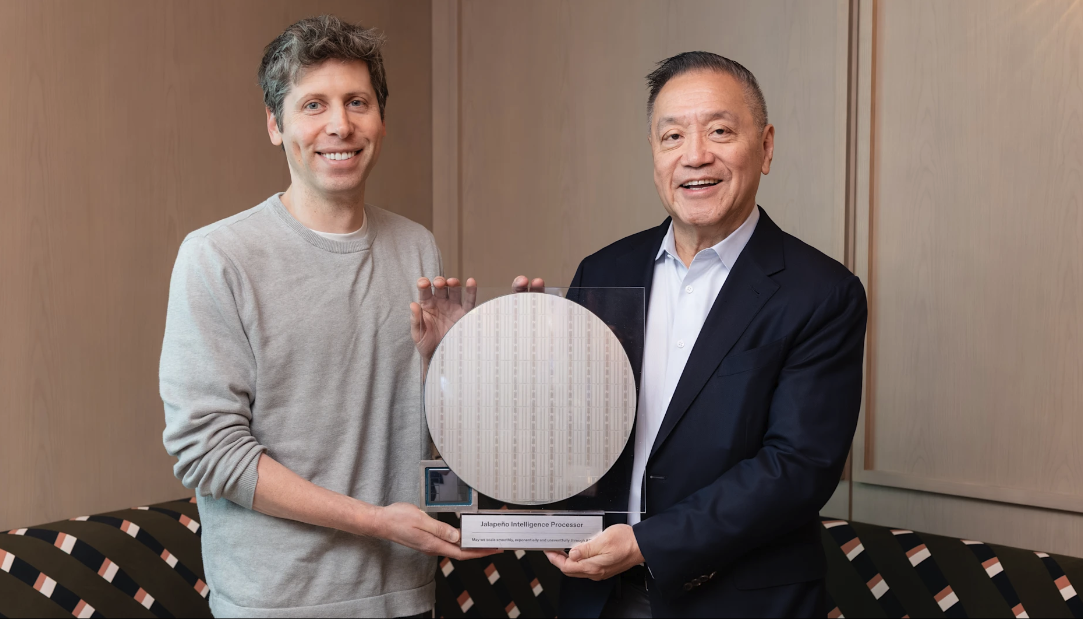
image description
As the chip is set to be integrated into data centers of partners such as Microsoft within the year, OpenAI is seeking to strengthen its AI growth flywheel through a full-stack approach combining models, applications, and computing power.


June 24 News — On Wednesday evening Beijing time, OpenAI showcased for the first time its custom artificial intelligence chip developed in collaboration with Broadcom, demonstrating the efforts of a leading large-model giant to gain competitive advantage through custom chips.


Seemingly inspired by Intel CEO Lip-Bu Tan’s photo last year holding an 18A chip wafer, the two companies also released a photo of Altman and Broadcom CEO Hock Tan holding a custom chip wafer.


The two companies stated on Wednesday that OpenAI has received the first batch of chip samples named Jalapeño and is testing the chip’s performance when running AI workloads. The announcement noted that early testing shows the chip will be significantly superior in performance per watt compared to current state-of-the-art levels.


OpenAI introduced that Jalapeño is not a chip assembled from general-purpose AI GPU cores, but rather a chip specifically redesigned by OpenAI for large language model inference. As a full-stack AI company that simultaneously develops large models, AI application products, and designs its own computing infrastructure, the entire system can be optimized around a single goal: making large models faster, more reliable, and cheaper for users.


Hock Tan also told media on Wednesday that so far, the Jalapeño accelerator has demonstrated approximately 50% cost savings compared to typical AI graphics processing units.


The two companies also stated that Jalapeño will further strengthen OpenAI’s growth flywheel: better infrastructure improves computing efficiency; improved computing efficiency enables better training and deployment of models; stronger models lead to better product experiences; better products attract more users, developers, and enterprise customers, generating more revenue; and this revenue can continue to be invested in next-generation infrastructure.


It is reported that the final version of the OpenAI chip will be integrated into data centers of partners such as Microsoft later this year. Hock Tan expects that the collaboration with OpenAI should exceed his previous forecast of deploying 1.3 gigawatts of chips next year.


It is worth noting that, with the support of OpenAI’s AI, Jalapeño took only nine months from initial design to manufacturing tape-out. The two companies claim this is “the fastest ASIC development cycle in the history of high-performance advanced semiconductors.”


Hock Tan introduced that the two companies already have a roadmap for future chips, with the next generation planned for launch in 2028, followed by an annual release cadence. Although Jalapeño focuses on inference tasks, OpenAI may also consider other workloads in future chip generations.


In addition to purchasing Nvidia chips and developing its own chips, OpenAI is also actively expanding its supplier base. The company has already reached multibillion-dollar deals with AMD and Cerebras.


As for the question highly watched by capital markets — “where does OpenAI’s money come from” — as of today, the parties still remain vague. Earlier reports said OpenAI plans to invest tens of billions of dollars in Broadcom chips.


Earlier this year, OpenAI raised $122 billion in funding to support its heavy investment in chips, data centers, and talent. The company has also reached financing agreements with suppliers including Nvidia and AMD, although these deals have been criticized for their “circular financing” nature.


Richard Ho, OpenAI’s head of hardware, declined to disclose how the company will finance these chips, noting that financing arrangements will be finalized after all processor orders are completed. Hock Tan also declined to comment, but reiterated that Broadcom has established a chip financing vehicle with private equity giants Apollo Global Management and Blackstone, which will also help OpenAI.



Leave a Comment

Your email address will not be published. Required fields are marked *